Heather’s Bookshelf: Author Interview with John Burt

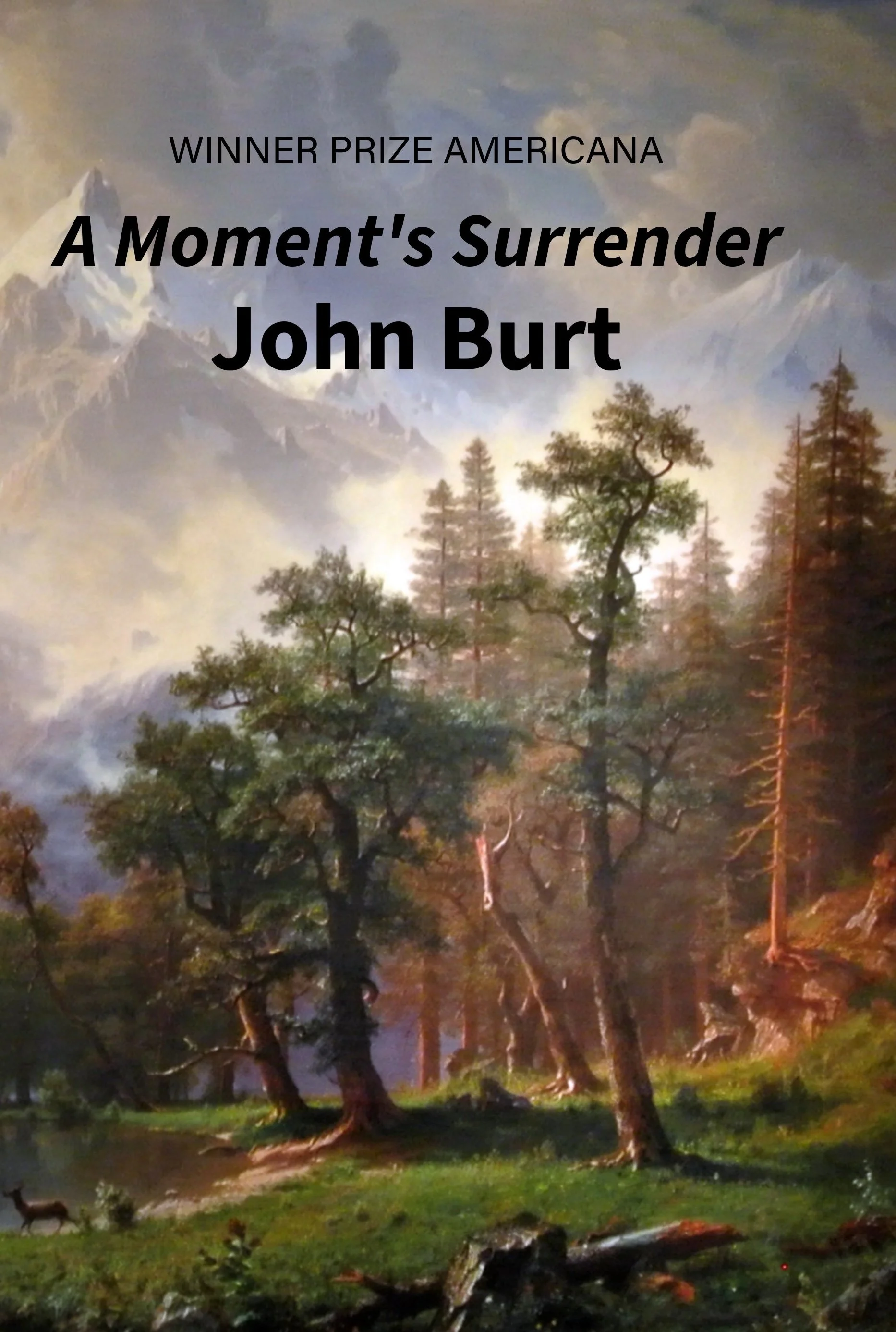
Book Title: A Moment’s Surrender
Released: 05/18/26
Genre: Adult Literary Fiction
Interview by Heather L. Barksdale
What inspired you to write “A Moment’s Surrender”?
Burt: Part of the story is true. Just after I left The University of Nevada-Reno in 1980 my room-mate, who like me was teaching First-Year Writing there (but who was also a very talented poet), was visited by a poet friend from California who told him that he was going to leave his wife that very day, and would drive from Reno directly to his girlfriend’s house. My room-mate’s friend actually was murdered by a hitch-hiker later that day at some point before it was clear where he was going (the wife and the girlfriend lived in different cities). My room-mate was in a less fraught situation that my protagonist Paul Bishop was, however, because the actual widow knew her husband was seeing someone else and that their marriage was on shaky ground. The murder was devastating for all the survivors, including my room-mate. He published poems about it, but never wrote the novel about it that he talked about with me. He died young, in 2001. In 2021, for reasons I still don’t understand, I began to think about the story, and added the complications that the girlfriend would be the protagonist’s ex, about whom he still had raw feelings, that the murdered poet had, ten years earlier, broken up the protagonist’s relationship with her, and that the protagonist, for a host of motives, some of them generous, some of them morally gray, would make it his business to shield his friend’s widow from the knowledge of what her husband was about to do to her. The protagonist comes under the spell of a fantasy about rescuing the widow, a spell which felt to him very much like love. When, accompanying her to the town where her husband’s killer is being arraigned, the protagonist discovers that the widow is terminally ill (another plot detail not drawn from the actual events), he commits himself, without a clear idea of what he is getting into, to standing by her to the end, and to caring for her small son. The murdered poet’s girlfriend, whom the widow does not know, is also at the arraignment, and the protagonist’s presence there at the widow’s side entangles him between the girlfriend (who has complicated feelings about him) and the widow.
How did you come up with the names of your main characters?
Burt: Sometimes just from the sound of a character’s name you know what kind of person they are intended to be. In Henry James’ novel The Wings of the Dove, for instance, you know from her name that “Milly Theale” must be an innocent, and that the novel will somehow turn on her vulnerability. And you know that “Kate Croy” will be knowing, charismatic, and someone whose self-confidence will lead her right up to a moral line she knows she shouldn’t cross but will. (I think that’s because her surname suggests “Crow.” But even the “Kate” part of her name suggests a force of will one doesn’t expect from “Milly.”) In my own book I think the assonance on that long dark “A” in the name “Rachel Lake,” suggests both an element of transgressive sexual knowledge and a commanding personality, both keys to Rachel’s character. The name Tom Corbin also has a dark side (because his surname suggests a raven). I named Corbin’s wife Susan because I thought (as with Milly) Susan was a name that carried a much smaller sexual charge than the name Rachel does. The name Paul Bishop suggests a fastidious, rule-bound person, which, until he makes his leap with Susan, he basically is. But there was also a silly inside joke in my choice of the name, because “Corbin’s Corner” and “Bishop’s Corner” were neighborhoods on opposite sides of my home town when I was growing up. I wanted the reader to feel a little emotionally closer to the two female characters than to the two male ones. So for the first part of the novel I always refer to the female characters as Susan and Rachel and to the male characters as Bishop and Corbin. Something transformative happens in Bishop's mind during his first long conversation with Susan, so from the moment he asks her to call him by his first name the narrator too calls him Paul whenever Susan is in the scene (but reverts to calling him Bishop whenever Rachel is in the scene). Jack Corbin, Tom and Susan’s small son, has a first name that suggests boldness and self-command. But that name reflects his father’s wishful thinking about him. Jack is in fact a very vulnerable child, and he is haunted by the fact that he intuits every trouble that his parents try to shield him from; his pathos is that he longs to protect his mother from death and knows that he can’t do that. As Susan remarks late in the novel, Jack somehow seems to be more Paul’s son than Tom’s.
Is there anything that you want readers to know about you, your writing process or your book?
Burt: I came extremely late to prose fiction. I was a professor at Brandeis University for over forty years, and published A Moment’s Surrender only in the year of my retirement. But in addition to my scholarly work on Lincoln and Robert Penn Warren I published three volumes of poetry in my career, most of it narrative poetry in blank verse. I had not written prose fiction since junior high school. But every professor believes they have a novel in them, and as my career began to draw to a close I decided to see whether I could actually write mine. I was amazed at how little forty years of teaching students how to read novels taught me about how to write one. I learned that you make a thousand small commitments on every page, and you have to be sure that they all connect with each other, and that every detail pulls some thematic weight. I learned also that passages of dialogue should not go the way either interlocutor expects them to go, and that the characters who believe they have the upper hand in a conversation may well be wrong about it. I think I still have very far to go to fully understand how a novel should be put together, but I have come to very much enjoy savoring the characters and solving the plot problems.
If "A Moment’s Surrender" was adapted into a movie, who would you like to see cast to play your lead characters?
Burt: This is a very hard question. I’ve been asked it before, and I think the answers I gave were not very good ones. So for this interview I started over again and threw a wide net looking for a possible cast. Rachel Lake was the easiest to cast. In the film Oppenheimer, the way Florence Pugh played Jean Tatlock, the psychiatrist who killed herself after a turbulent affair with the great physicist, showed the same rage, the same self-destructiveness, the same sexual fierceness, but also the same existential loneliness I had in mind for Rachel. The restrained but deep passion Saoirse Ronan brought to playing Jo March in Little Women and Nina in The Sea Gull showed all the gravity and dignity I wanted for whomever would play Susan. For Tom I thought of Adam Driver, because I thought he has the ability to hold a shadowed but electric masculinity in the same hand with a strong sense of shame and even a touch of moral despair. I think Tom Hiddleston could play that role also, and if I didn’t fear going back to Oppenheimer for another role I could imagine Cillian Murphy as Tom as well. For Paul, my first instinct would be to look at Barry Keoghan, since I think he can put together repression, intelligence, self-doubt, vulnerability, and a sense of his own insignificance while at the same time preserving an understated dignity. But I could imagine Paul Mescal in that role too, on the basis of his performance as Connell in Normal People.
If you could have dinner with any character you’ve written, who would it be—and what would you talk about?
Burt: That’s a complicated question. The character I would most want to ask questions of would be Susan Corbin. I’d want to know where she got her resilience, her ability to face down so much defeat and so much tragedy without losing her love of life and ability to care for her son. But could I really ask her that to her face? And could she actually put into words how she does it? Does she even see herself in the idealized way I see her? I could, however, actually imagine a dinner with Rachel Lake, who would be a risky but thrilling person to know. I’d want her to talk about her poems, and her ideas about what poetry is. In the arguments Rachel, Tom, and Paul had about poetry as graduate students her views were the most interesting, but also the most enigmatic, and although Tom earned fame as a poet, only Rachel’s poetry is ever quoted word for word in the novel. I’d want her to walk me through some of her poems, hoping as a reader not to be just Thomas Wentworth Higginson to her Emily Dickinson.
When you encounter writer’s block, what do you do to break yourself out of it?
Burt: In every writer there are two different writers who have to work out a modus vivendi with each other. One writer is always restlessly, but also uncritically, generating new possibilities, looking at new angles, making new combinations, creating new twists. The other writer is always testing what the first generates, asking whether it makes sense, whether other readers could buy it, whether it’s plausible, or interesting, or suggestive. The first writer is directed inward, asking “What do I think?” or “What would be really neat if it were true?” The second is directed outward, asking “Will this make sense to anyone?” or “Does this seem ridiculous?” When the first writer gets the upper hand, what you write has inventive moments, but also a lot of nonsense and BS. When the second writer gets the upper hand, nothing that it is imaginable for you to say can possibly pass muster, and you write nothing at all. Worst of all, you reject promising ideas because of apparent flaws in them that you would be able to work out if you gave them enough patience. Over a writing project the center of gravity begins with the first writer, giving you the freedom to scoop up an idea from the bottom of the pool before you muddy the water with second thoughts; but ends with the second writer, making sure that what you brought up from the depths is really the genuine article.
When you have writer’s block, you imagine that you have nothing to say. But that is rarely what is actually happening. When you have an idea, it comes to you with nuances, hesitations, qualifications, and a long train of implications stretching ahead into the darkness. It’s a multidimensional object that has parts you can’t see when you look at it only from one point of view. But words come halting forth one at a time, and everything you say in the early going seems to lack the nuance and depth you saw in the idea, because you can only put a little bit of your thought on the page at a time; at best, what you write will seem like an oversimplification of your idea, and at worst it will seem like a betrayal of that idea. A rich idea is more like a Thou than like an It; nothing you actually say will fully do it justice, and there will always be something left unsaid, something you didn’t shine a light on. The mismatch between the rich complexity of the idea and the thin stream of words we play over it can be very daunting. I think writer’s block is not a problem of having too little to say, but of having too much to say. As T. S. Eliot puts it in “East Coker”:
And so each venture
Is a new beginning, a raid on the inarticulate
With shabby equipment always deteriorating
In the general mess of imprecision of feeling,
Undisciplined squads of emotion.
Eliot’s remedy for this is a little grim, but probably the best anyone can do:
There is only the fight to recover what has been lost
And found and lost again and again: and now, under conditions
That seem unpropitious. But perhaps neither gain nor loss.
For us, there is only the trying. The rest is not our business.
What’s the weirdest or most unexpected place you’ve gotten a story idea from?
Burt: The novel I’m working on now got its start almost fifty years ago. I was studying in the stacks of the library in college, and I noticed a row of similarly-sized books in front of me, in which one volume was very noticeably shorter than all of the others. The books were the proceedings of international genetics conferences, and the short one was a conference that was going on in Edinburgh during the week before the outbreak of the Second World War. Stalin forbade the Soviet geneticists from attending, because he had turned against Mendelian genetics. (Over the next few years he would kill almost all of them.) The Polish geneticists were stranded in Britain and were never able, even after the war, to return home. The American and British geneticists were there to make a statement against Eugenics, although they had mostly been implicated in it earlier in their careers. There were even German geneticists there (a surprising number of them women) although I didn’t sense any Nazi tendencies in the papers they submitted. Did they defect, or did they return to Germany in the last few days of peace? That must have been some conference!
What is your favorite genre, book, and/or author?
Burt: That’s like asking me to choose my favorite child! I’ve always been taken with that strain of dark romantic fiction that goes back from Cormac McCarthy through Faulkner and James to Melville and Hawthorne. The book I keep coming back to is Robert Penn Warren’s All the King’s Men, a novel about politics which seems particularly appropriate to the present moment (and has seemed appropriate to almost every present moment since it was written). But what has swept me away most powerfully over the last few years have been the Gilead novels by Marilynne Robinson, and Vasily Grossman’s dark epic about Stalingrad, Life and Fate. The manuscript of that novel was confiscated just as Grossman completed it in 1962, and Grossman died believing it had been destroyed. But a hidden copy was smuggled to the United States in 1980 and appeared in English translation almost immediately. Grossman wrote in the Soviet Realist style, but I can’t think of another book which captures so powerfully what it is to live in a world in which it is nearly impossible to keep one’s morality alive.
What are you working on next?
Burt: I’m working on a novel about that 1939 genetics conference. I have some sense of what the large-scale issues will be, since I was a biochemistry major in college, but I’ve only recently figured out what the close-in conflicts among the central characters will be. There will be conflict among the American geneticists, one or two of whom fought in Spain, but who mostly hate the Nazis but don’t want to join the coming war. And there will be conflict among the German geneticists, who don’t trust each other, about whether and how to defect. The heroine will be a German geneticist who begins an affair with a married (and not very reliable) American assistant professor whom she hopes will help her defect. But she is also in anguish about leaving her small daughter in the care of her Nazi-adjacent husband.
Learn More About the Author and A Moment’s Surrender here:
Interested in checking out the book for yourself?
Find it for purchase here
Interested in submitting your book for review? Visit my review page for guidelines and submission requirements.
review